Have you ever made a sugar scrub that felt wonderful going on but left your skin covered in oil afterward?
That’s one of the reasons I like emulsified sugar scrubs.
An emulsified sugar scrub has a creamy texture and is designed to transform when it comes into contact with water, making it easier to rinse away than a traditional oil-and-sugar scrub. Once you understand what each part of the formulation does, the process isn’t nearly as complicated as it might seem.
In this guide, I’m going to show you how an emulsified sugar scrub comes together, explain the purpose of the different types of ingredients, and walk you through the basic process from melting the base to filling your jars.
I’m not sharing my exact formulation or measurements here. I’ve spent time developing and testing my own formulation, and I’ve put those exact measurements and batch instructions into a separate printable formulation guide for those who want to make the same type of scrub.
What Makes an Emulsified Sugar Scrub Different?
A simple sugar scrub can be made by combining sugar with an oil or butter. An emulsified sugar scrub takes things a step further.
An emulsified formula contains ingredients that allow the oil-based portion of the scrub to interact with water. When you rinse the scrub from your skin, the product becomes creamy and milky rather than simply leaving a layer of oil behind.
That emulsifying system is one of the key differences between a traditional sugar scrub and an emulsified sugar scrub.
Understanding the Ingredients
You don’t need a long list of complicated ingredients to understand how an emulsified scrub works. Each component has a particular job.
Butters
A plant-based butter forms part of the rich, creamy foundation of the scrub.
Butters contribute to the texture and help give the finished product a luxurious feel. Different butters can produce noticeably different results, so changing the butter in an established formula isn’t necessarily a simple one-for-one substitution.
Liquid Oils
Liquid botanical oils contribute conditioning properties and help determine how the scrub feels when it is applied.
The choice of oil can affect the finished texture, spreadability, and skin feel. This is one reason I prefer to formulate rather than simply substitute oils based on what happens to be sitting in the pantry.
Fatty Ingredients
Some ingredients in an emulsified scrub aren’t there primarily for their skin-conditioning properties. They help build structure.
Fatty acids and fatty alcohols can contribute firmness, body, and a smoother texture to the finished product.
These ingredients can be particularly important when you’re trying to create a scrub that is thick enough to scoop but still easy to spread.
Emulsifying Agent
The emulsifying ingredient is an important part of what makes this an emulsified scrub.
It helps the oil-based ingredients interact with water when the scrub is rinsed away. Without an appropriate emulsifying system, you don’t have the same type of rinse-off experience.
Sugar
Sugar is the exfoliating portion of the scrub.
You can experiment with different types and grain sizes, but remember that changing the sugar can change the texture of the finished product. A finer sugar will generally produce a different experience than a coarser sugar.
Fragrance
Fragrance is completely optional, but it’s one of my favorite ways to create different varieties.
When making a cosmetic product, always use a fragrance specifically intended for the application you’re making and follow the supplier’s recommended usage rate. Fragrance isn’t something to simply add until the product “smells right.”
Preservative
A preservative is an important consideration for products that can come into contact with water during use.
Even though sugar scrubs don’t contain a large amount of water in the finished formula, water can be introduced during use when someone reaches into a jar with wet hands.
Use a preservative appropriate for your formulation and follow the manufacturer’s recommended usage rate and processing instructions. Preservative systems aren’t interchangeable, so this isn’t an ingredient I’d recommend guessing about.
Mica Colorants
If you want to add color, cosmetic-grade mica can give an emulsified sugar scrub beautiful color and a little shimmer.
I like adding mica when I want a particular color to coordinate with the fragrance or create a more visually appealing product.
A few things to keep in mind:
- Use a mica intended and permitted for cosmetic use and the area of application.
- A little can go a long way.
- Disperse the mica thoroughly to avoid streaks or pockets of concentrated color.
- Different micas can behave differently in a finished formulation.
- Check your supplier’s documentation for appropriate cosmetic use.
If you’re making products to sell, don’t assume that because a colorant is sold as “mica” it is automatically appropriate for every cosmetic application.
The Basic Process
Once you understand what the different components do, the process becomes much easier to follow.
1. Prepare the Oil Phase
Begin by combining the ingredients that need to be melted together.
The mixture is heated until the solid ingredients have completely melted and everything is uniform.
The exact temperature and heating procedure will depend on the ingredients you’re using, so follow the requirements of your particular formulation.
2. Cool the Mixture
Once everything has melted and been thoroughly combined, allow the mixture to cool.
For the formulation I use, I allow the mixture to become solid before whipping it.
This step is important because the consistency of the mixture affects how the finished scrub comes together.
3. Whip the Base
Once the mixture has solidified, whip it until it becomes light and creamy.
This is where the texture starts to change.
Don’t rush this step. The goal isn’t simply to stir the mixture; you’re incorporating air and creating the texture that will eventually hold the sugar.
4. Add the Sugar
Once the base has been whipped, gradually incorporate the sugar.
Mix thoroughly so that the sugar is distributed evenly throughout the base.
At this point, you’ll begin to see the familiar texture of a sugar scrub develop.
5. Add Color
If you’re using mica, this is where you can incorporate your cosmetic-grade colorant.
Add a small amount and mix thoroughly before deciding whether you need more. It’s much easier to add additional color than it is to correct a batch that has been over-colored.
If you’re making multiple colors from one batch, divide the scrub into separate portions before adding your different mica colors.
6. Add Fragrance and Preservative
Add your fragrance and preservative according to the formulation you’re following.
Mix thoroughly after each addition so everything is evenly distributed throughout the scrub.
This is one reason I recommend weighing your ingredients rather than measuring by volume. Consistency matters when you’re making a repeatable formulation.
7. Package the Scrub
Once everything has been thoroughly incorporated, transfer the finished scrub into clean, dry containers.
Avoid introducing water into the jars during filling.
If you’re making products to sell, your packaging, preservation, labeling, and testing are all important parts of the finished product.
What Should the Finished Scrub Look Like?
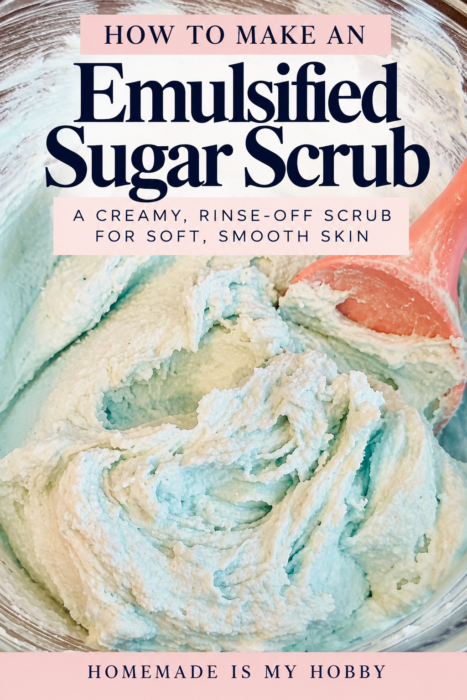
A well-made emulsified sugar scrub should have a creamy, scoopable consistency.
It shouldn’t be so hard that you have to fight with the spoon to get product out, but it also shouldn’t be so soft that it immediately collapses into an oily puddle.
When water is added during use, the scrub should emulsify and rinse away more easily than a simple oil-and-sugar scrub.
Texture can vary depending on the ingredients, proportions, sugar type, fragrance, colorants, and processing method.
A Few Tips for Better Results
Weigh Your Ingredients
A kitchen measuring cup isn’t enough when you’re trying to reproduce a cosmetic formulation.
Use a digital scale and weigh your ingredients in grams. This gives you much better consistency from batch to batch.
Don’t Change Several Things at Once
If you’re experimenting with a formulation, change one variable at a time.
If you change the butter, oil, sugar, fragrance, and emulsifier simultaneously, you won’t know which change caused the difference you see.
Keep Good Batch Notes
Write down what you made and what happened.
Record things such as:
- Texture
- Whippability
- Sugar type
- Fragrance
- Colorant
- Appearance
- Rinse-off feel
- Any changes after sitting
Those notes become extremely valuable when you’re developing your own formulations.
Frequently Asked Questions About Emulsified Sugar Scrubs
What is an emulsified sugar scrub?
An emulsified sugar scrub is a sugar-based exfoliating product that contains oils, butters, and an emulsifying system. When water is introduced during use, the scrub emulsifies, creating a creamier mixture that rinses away more easily than a traditional oil-based sugar scrub.
What is the difference between an emulsified sugar scrub and a regular sugar scrub?
A traditional sugar scrub is generally made by combining sugar with an oil or butter. An emulsified scrub contains an emulsifying system that changes how the product behaves when it comes into contact with water.
This can give an emulsified scrub a creamier application and a less oily rinse-off experience.
Does an emulsified sugar scrub contain water?
The finished formulation does not necessarily contain added water. However, water can be introduced during use when the product comes into contact with wet hands or skin.
That’s one reason preservation and good manufacturing practices are important even when you’re working with a scrub that doesn’t have water listed as an ingredient.
Can I use any oil or butter in an emulsified sugar scrub?
Not necessarily.
Different oils and butters have different properties and can change the texture, stability, and skin feel of the finished product. Substituting ingredients can mean that a formula no longer performs the way it was originally designed.
If you’re working from an established formulation, it’s best to follow the formulation rather than making substitutions without testing.
Can I use different types of sugar?
Yes, but the type and grain size of the sugar can affect the finished scrub.
Finer sugar will give you a different exfoliating experience than a larger-grain sugar. Changing the sugar can also change the overall texture of the finished product.
Can I add mica to sugar scrub?
Yes, cosmetic-grade mica can be used to add color and, depending on the mica, shimmer.
Always check that the specific colorant is appropriate for the intended cosmetic application and follow the supplier’s usage recommendations.
Start with a small amount because mica can be surprisingly concentrated.
Can I make different fragrances from one batch?
Absolutely. One of the easiest ways to make several varieties from a single batch is to make the base first and divide the finished unscented scrub into separate portions.
You can then add the appropriate fragrance and color to each portion.
The important part is to calculate the fragrance and other additions based on the amount of product in each portion rather than simply adding the same amount to every bowl.
How do I know how much fragrance oil to use?
Fragrance should be calculated based on the formulation and the supplier’s recommended usage rate for the intended application.
More fragrance does not necessarily mean a better-smelling product. Using too much can affect the finished product and may make it unsuitable for its intended cosmetic use.
Why does my sugar scrub become too hard?
Several things can affect the firmness of an emulsified scrub, including the types and proportions of butters, oils, fatty ingredients, emulsifier, and sugar.
Temperature and cooling conditions can also affect the final texture.
If you’re troubleshooting a formula, change one thing at a time so you can identify what caused the difference.
Why is my sugar scrub too soft?
The same principle applies in the opposite direction. The balance of liquid oils, butters, structural ingredients, sugar, and processing conditions all contribute to the final consistency.
Rather than simply adding more sugar, it’s better to understand which part of the formulation is responsible for the texture you’re trying to achieve.
Can I sell homemade sugar scrubs?
If you’re making cosmetic products for sale, there are additional responsibilities beyond simply creating a recipe. You’ll need to consider appropriate ingredients, preservation, safety and stability testing, packaging, labeling, record keeping, and applicable cosmetic regulations.
Making a product for yourself is very different from producing one for customers.
Make the Formulation Simple to Reproduce
If you’d rather not spend time working out percentages, calculating batch sizes, or figuring out how much of each ingredient you need, I’ve put my formulation into a printable guide you can keep with your other recipes and formulations.
This is the formulation I use, with the proportions worked out and tested so you have a practical starting point rather than having to develop the balance yourself.
The guide includes:
- Exact measurements for each ingredient
- The complete step-by-step formulation
- Fragrance and preservative amounts
- Batch-sizing calculations for different jar sizes
- Instructions for splitting a batch between fragrances
- A simple printable format for your formulation binder
Whether you’re making a small batch for yourself or preparing multiple jars, the batch-sizing information saves you from having to pull out a calculator every time you make it.
Emulsified Sugar Scrub Formulation
$6.99
[Get the Printable Formulation →] Emulsified Sugar Scrub Formulation
This is a formulation I’ve developed and tested through my own making process. As with any cosmetic formulation, your own ingredients, equipment, and process can affect the finished product, so appropriate testing is recommended before making products for others.